


What are food sensitivities or food intolerances?
Does your cat suffer from frequent digestive issues, itchy skin, or unexplained discomfort? These could be signs of cat food intolerances or a feline food allergy. In this guide, we’ll explore the causes, symptoms, and best dietary solutions to keep your cat happy and healthy.
Cat food allergies are slightly different, strictly speaking, from cat food intolerances. Allergies involve an immune reaction, usually to a protein. Intolerances are an abnormal response to a food or food additive. Whether your cat has an allergy or an intolerance, the diagnosis and treatment is the same, so you don’t need to get hung up on the difference. Both are known as an adverse food reaction (AFR), or sensitivities.
Sensitivities may last a lifetime, so the ingredient must be permanently removed from your cat’s food. It’s worth bearing in mind that your cat might be allergic to more than one protein, too.
What causes food allergies or food intolerances?
The most common causes of food sensitivities in cats include:
- Protein: Sensitivity is most commonly associated with protein sources, usually from chicken, beef, fish or dairy products in your cat's food.
- Damage: Inflammation, infection, surgery and some medications can damage the digestive system and may lead to adverse food reactions.
- Breed: Some cat breeds appear more likely to develop food sensitivities, including Siamese cats.
It may take months or years before your cat develops a sensitivity to a particular food. However, once they develop one, they will almost always have a negative reaction to that food.
What are the signs of cat food sensitivities?
The most common signs of a cat food allergy or intolerance are:
- Diarrhoea and vomiting
- Itchy skin that persists year-round, particularly on the face, ears and neck
- Over-grooming and related hair loss on the tummy and sides
- A bumpy, crusted skin rash
Other signs of food sensitivities might include:
- Lethargy
- Signs of abdominal pain or discomfort. This can be as subtle as playing less or withdrawing from the family.
- Poor coat condition
- Flatulence
- Frequent scratching
- Red, inflamed skin
- Poor growth
- Coughing, wheezing or sneezing
- Chronic ear problems
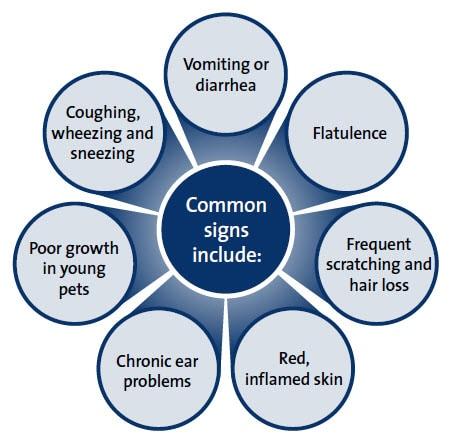 Because there are many other conditions, some of which are serious, that have the same signs as cat food allergies and intolerances, it’s important to see your vet if you notice any of these signs.
Cat food allergies vs environmental allergies
Cats can be allergic to many things as well as food. Environmental allergies are called atopy or atopic dermatitis. They can produce skin signs in cats almost identical to a food allergy. Environmental allergens are things like dust, dust mites, fleas, pollen, grass and mould etc. Of course, some unfortunate cats may have atopy and a food allergy. Some of these can also manifest as feline asthma, with respiratory problems. Your cat may also have a contact allergy to something in their environment, such as a plastic food bowl.
Your vet may want to do skin tests or blood tests for atopy. Find out more about atopy in cats.
How are food allergies and intolerances diagnosed?
Because of the overlap with environmental allergies, diagnosing a food sensitivity can take a little time and needs to be approached in a logical, stepwise way. Please be patient with your vet while they rule things in and out.
The simplest way to diagnose an adverse food reaction is with something called an elimination trial. This is, as it sounds, a period of time on a special food that your cat won’t react to. Most vets now use a hydrolysed diet. This is one where the proteins have been broken down into tiny fragments that are too small to be recognised by your cat’s immune system. They usually have a carbohydrate source that is refined to make sure there are no protein elements to cause a reaction. In theory, these diets can be fed to any cat with any adverse food reaction.
For gastrointestinal issues associated with adverse food allergies, you usually see a great improvement in 2-4 weeks. For skin issues, you may need to feed your cat the special food for 12 weeks because the skin takes longer to heal than the gut.
It’s very important during this time to make sure that no other foods or treats are given, otherwise you might negate the whole trial and have to start again.
At the end of the trial, if your cat is free of symptoms, you can simply continue with the same food if your vet feels that’s appropriate. Or, if you want to be able to offer your cat variety, you can do food challenges to find out exactly what the culprit(s) may be. To do this, continue with the trial food and then add one protein for a couple of weeks and see if the signs start up again. For instance, you can add some cooked chicken breast as a topping every day. If that’s fine for a few weeks, then you could try beef, and so on. This way, you may be able to feed your cat normal cat foods that simply avoid the offending ingredients.
Some labs offer blood tests for food allergies. Don’t spend your money on these. They are not currently reliable for food allergies. Blood tests for environmental allergens are reliable and can be useful when looking at treatment options.
What are the best diets for cats with food allergies and intolerances? Are there safe food alternatives?
As we just said, if you find out definitively what your cat is reacting to, you may be able to feed it any quality cat food that doesn’t contain that ingredient. This can be difficult in some circumstances because not all foods list all the ingredients and some cats are allergic to several food ingredients. In these cases, we usually recommend one of the following options:
- Hydrolysed diets are what we described for the elimination trial. They are diets that have had the proteins broken into fragments that are too small for the body to recognise.
- Novel protein diets are ones where the protein source is one that your cat has not had before. Of course, this will depend heavily on your cat’s feeding history. Common proteins for these diets are duck, venison or rabbit, and more recently, insect protein diets.
Your vet will be able to advise about which would be most suitable for your cat specifically.
In summary
Cat food sensitivities are not very common, but they do occur, and when they do, they are for life. That said, with the right foods, the vast majority of cats with adverse food reactions can live perfectly normal lives. Most pet parents will find at least one thing they can give as an extra treat now and then as well.
If you have any worries about your cat and a possible allergy, or any health problem, seek advice from your vet as soon as possible. The sooner you get to the bottom of the condition, the sooner your cat will get relief and the least damage will be done. After all, we all want as long with our furry, four-legged friends as we can possibly get!
Cat food allergies & intolerances FAQs
What are the signs of cat food sensitivities?
The most common signs of cat food sensitivities are
- vomiting and diarrhoea
- itchy skin that persists year-round, particularly on the face, ears and neck
- over-grooming and related hair loss on the tummy and sides
- a bumpy, crusted skin rash
How is a cat food allergy diagnosed?
This is done with an elimination trial. Usually, a hydrolysed protein diet is followed. This may be for up to 12 weeks for skin issues, usually less for gut issues.
What is the best hypoallergenic cat food?
This entirely depends on your cat and what they are allergic to and whether you have a comprehensive feeding history. Hydrolysed diets and novel protein diets are usually the easiest ways to feed cats with food allergies or sensitivities.
Can cats grow out of food allergies?
The vast majority of cats that develop food allergies or intolerances will need lifelong management. However, with the right foods, virtually all of them can live perfectly normal lives.
Written by Dr. Emma Milne BVSc FRCVS and Reviewed by Dr. Karen Shenoy DVM.

Related products
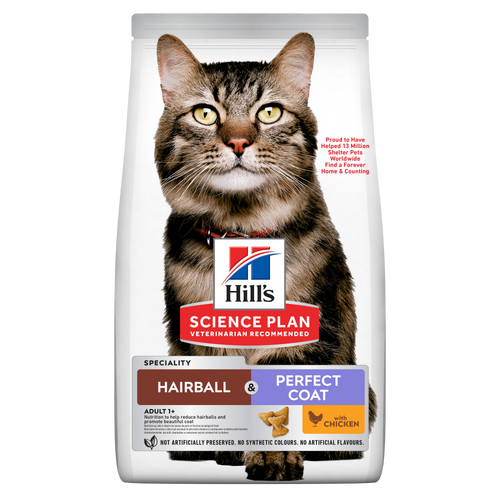
Hairball & Perfect Coat Adult Dry Cat Food with Chicken
Hill's Science Plan Hairball & Perfect Coat Adult Cat Food with Chicken is formulated to effectively help avoid hairball formation in adult cats while promoting a beautiful coat. Thanks to its mix of essential omega-6 fatty acids, this food benefits the cat's skin and fur, keeping them healthy and shiny. Our Advanced Fibre Technology helps reduce hairballs by naturally promoting their passage through the gut. This food is formulated with high-quality protein for a perfectly balanced, great-tasting recipe.
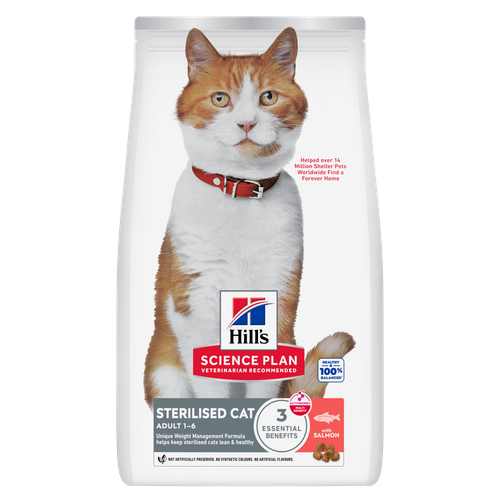
Sterilised Adult Cat Food
Hill's Science Plan Adult Sterilised Cat Dry Food with Salmon is specially formulated with ActivBiome+ Multi-Benefit Technology. It is a precisely balanced nutrition, tailored to meet the needs of sterilised cats, to help keep them lean & healthy.
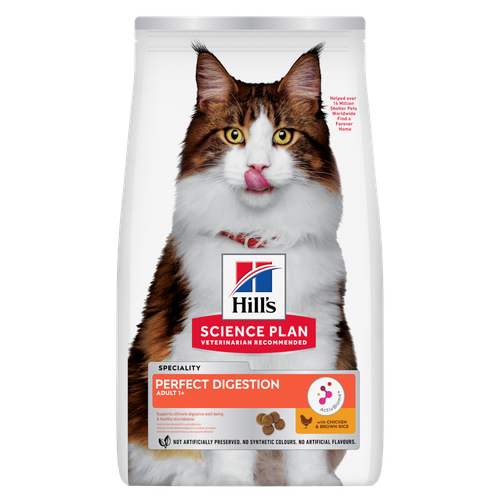
Perfect Digestion Adult Cat Food
Hill's Science Plan Perfect Digestion Cat Food with Chicken & Brown Rice nourishes your cat's unique microbiome and helps them reach their full potential.
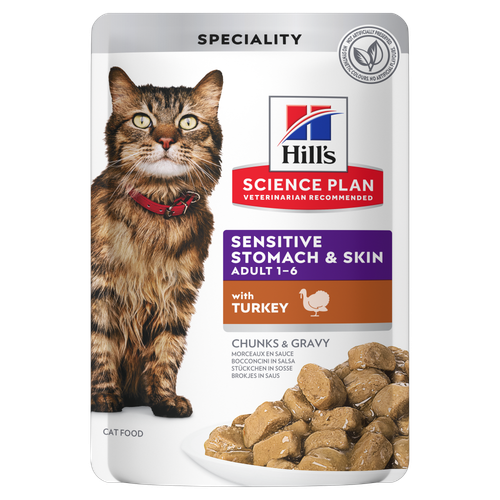
Sensitive Stomach & Skin Adult Cat Food
Hill's Science Plan Adult Sensitive Stomach & Skin Cat Premium Chunks in Sauce with Turkey is a complete pet food for adult cats aged 1-6 years
Related articles
How to deal with your Cat’s upset stomach
Lots of pets suffer from upset tummies from time to time. While the specific details sometimes don’t make pleasant reading, it’s important that you know what to expect.
Five Common Cat Digestive Problems: What To Do
Discover some vet-recommended advice about some common cat digestive problems, including how to deal with upset stomachs, worms, hairballs, and more.

Food Allergies, Intolerance & Your Cat's Sensitive Stomach
Learn about how food allergies might be responsible for your cat's sensitive stomach & vomiting, and how trying a hypoallergenic cat food can help.

Cat Allergic Dermatitis: Causes & Treatments
Learn about the causes of cat dermatitis, how to spot the symptoms and the best treatment options. Visit Hill's Pet for detailed guidance and tips.
Put your cat on a diet without them knowing
Our low calorie formula helps you control your cat's weight. It's packed with high-quality protein for building lean muscles, and made with purposeful ingredients for a flavourful, nutritious meal. Clinically proven antioxidants, Vitamin C+E, help promote a healthy immune system.
Put your cat on a diet without them knowing
Our low calorie formula helps you control your cat's weight. It's packed with high-quality protein for building lean muscles, and made with purposeful ingredients for a flavourful, nutritious meal. Clinically proven antioxidants, Vitamin C+E, help promote a healthy immune system.